ALL-22

Tactical Football Simulator

The chalkboard.

Seven ideas a staff wins with before the ball moves. Each one three ways: the football, the control that runs it in the Play Lab, and what the engine does about it.

The timeline

Run the clock you drew.

Pre-snap and post-snap on one track per man.

The football
A play is a schedule. The motion man hits his landmark as the ball is snapped. The receiver breaks as the quarterback hits the top of his drop. Coaches teach it in steps and counts, and the play lives or dies on the timing.
In All-22
The timeline opens at the set, with a Cadence lane on top. The + button adds a motion. Each man's track shows his phases: stem, break and settle for a receiver; the drop and the reads for the quarterback. Drag a clip or a break point and the route is retimed.
  • Cadence lane
  • + Motion
  • Stem
  • Break
  • Settle
  • Drop
  • Reads
The engine
The players run the timing you set, from the set to the whistle. Move a break and the route runs on the new count.
Try it in the Play Lab →

Snap count

Make them guess.

Quick, on 1, on 2, on 3, hard count, freeze.

The football
The count is a weapon. Snap it on the first sound and the rush is a step late. Hold it to two and a jumpy end has to sit on his hands. A hard count dares the defense to blink first.
In All-22
Pick the count in the Cadence lane, play by play.
  • Quick
  • On 1
  • On 2
  • On 3
  • Hard count
  • Freeze
The engine
Whether a defender jumps comes from the count, how much you vary it, and his discipline, awareness and play recognition. Your own false starts come from the count, the tempo and your linemen's discipline. A hard count can freeze them; then you snap it, take a timeout or take the delay.
Try it in the Play Lab →

Tempo

Speed is a call.

Huddle, no-huddle, hurry, check-at-line.

The football
Go fast and the defense lines up in what it has: less time to disguise, less time to get the call in. The bill comes due at the line, where the offense loses time too.
In All-22
Set the tempo. Check-at-line gives the quarterback the call: he picks the play at the line from his read.
  • Huddle
  • No-huddle
  • Hurry
  • Check-at-line
The engine
In fast tempo the defense has a harder time disguising and getting set the way it would after a huddle. The offense pays its share: it gives up its own kills and checks.
Try it in the Play Lab →

At the line

Name the front.

Over, Under, Bear, 5-2, nickel. Then the rules fire.

The football
Before the snap the quarterback names the front. The front tells him where the 3-technique sits, where the bubble is, and where the run belongs.
In All-22
Write the play's rules: kill or flip the run away from the 3-technique, toward the bubble, or to the numbers. Add a Now or Bubble screen off the corner's cushion or the slot's space. He gives the check with a hand signal.
  • 4-3 Over
  • 4-3 Under
  • Bear
  • 5-2
  • Nickel
  • Kill
  • Flip
  • Now screen
  • Bubble screen
The engine
How fast he names the front, and how often he names it right, comes from his recognition ratings. The defense can bait a front and slide back late.
Try it in the Play Lab →

Gap inserts

A, B, C.

Inserts, gap releases and cracks by letter.

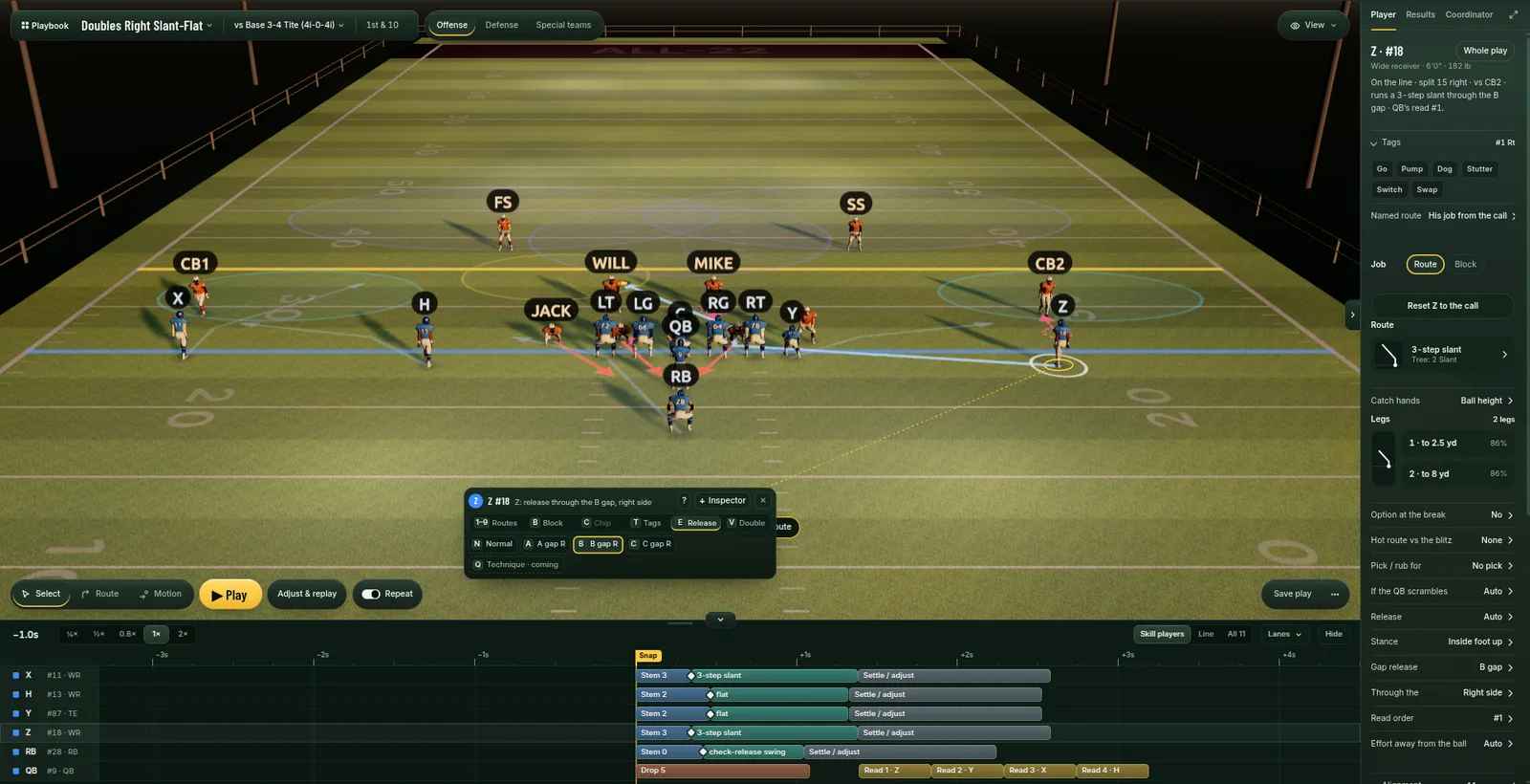
The Play Lab, one second before the snap on Doubles Right Slant-Flat: Z selected, his quick menu open on the field with Release set to B gap right, his slant drawn through it.
In the Play Lab: tap Z, open Release, pick B gap right. His slant now runs through the gap the line leaves him.
The football
Gaps count out from the center. A sits between center and guard, B between guard and tackle, C outside the tackle or between the tackle and a tight end. An insert sends a back into one of them. A crack sends an inside receiver down on the box.
In All-22
Give a back or fullback an insert, an inside receiver a crack, and any man a gap release, by letter: in the Inspector, or from his quick menu on the field.
  • Insert
  • Gap release
  • Crack
  • A
  • B
  • C
The engine
The gap is found from where the line stands on that snap: its splits, with or without an attached tight end. Widen the splits and the gaps move with them.
Try it in the Play Lab →
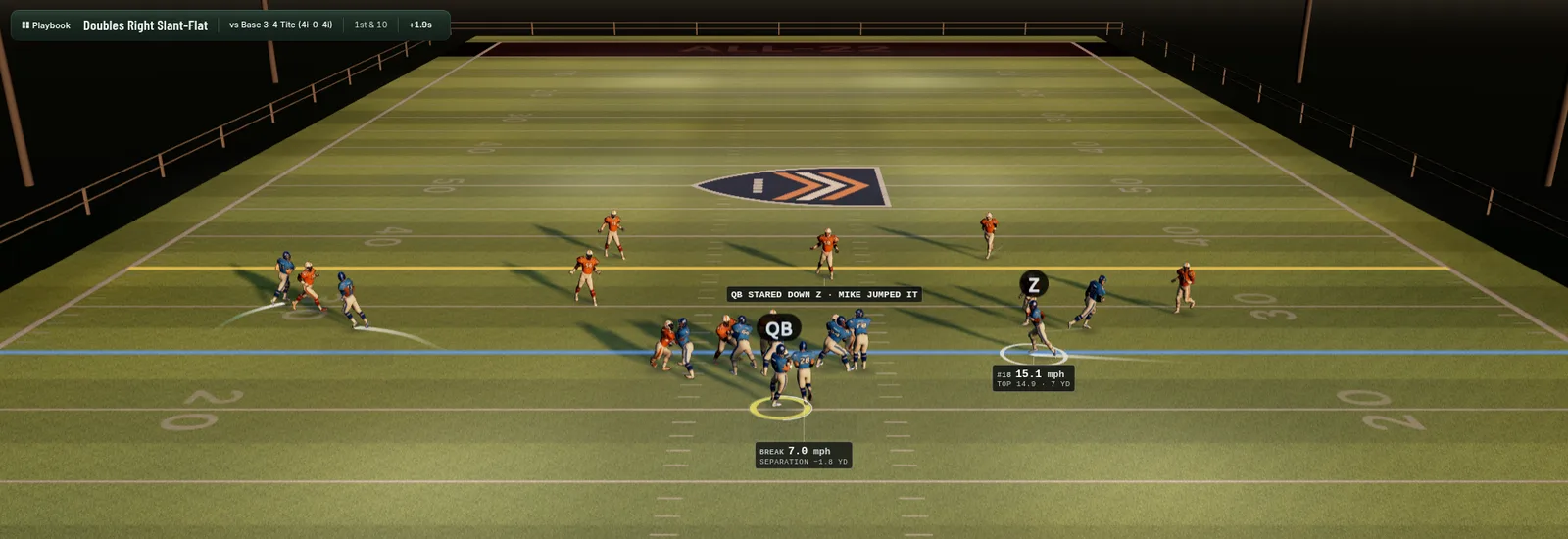
The same play on the field 1.9 seconds after the snap: Z through the B gap at 15.1 mph, the tag reads QB stared down Z, Mike jumped it.
On the field at +1.9 s: Z comes through the B gap at 15.1 mph. The quarterback stared him down, and the Mike jumped it.

WR motion

Make them show it.

Jet, orbit, across, zoom, return, short, insert.

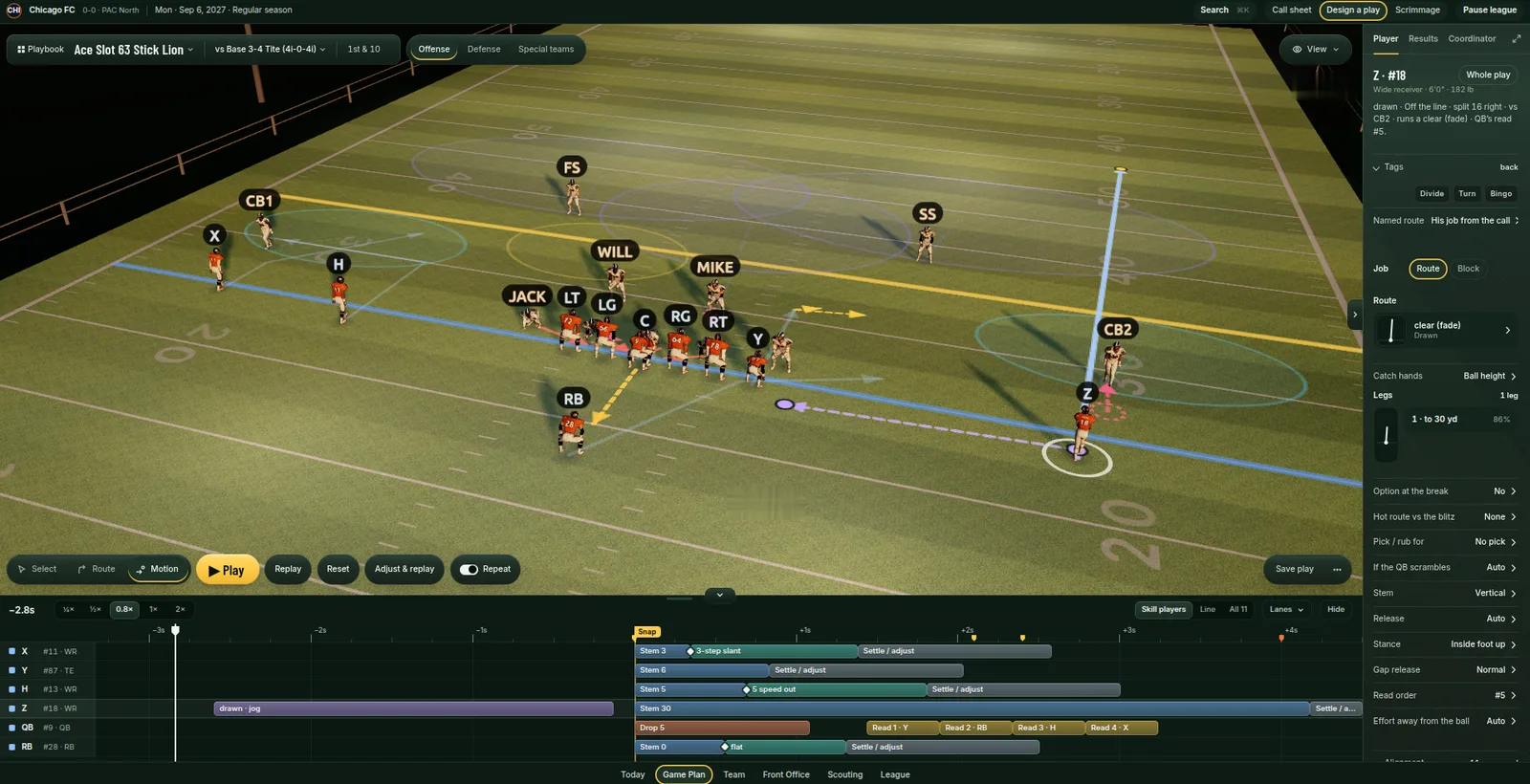
The Play Lab at 2.8 seconds before the snap: Ace Slot 63 Stick. Z's drawn jog motion sits on his timeline track, his path dashed on the field, his job open in the Inspector.
In the Play Lab: Z's motion is a clip on his timeline track, 2.8 seconds before the snap.
The football
Motion is a question the defense has to answer. Send a receiver across and watch who goes with him. A man defender travels; a zone shifts. The answer tells the quarterback man or zone before the snap, and the new spacing can buy leverage or set a rub.
In All-22
From the timeline +, add a preset motion or draw the path by hand. Any of them can stop short.
  • Jet
  • Orbit
  • Across
  • Zoom
  • Return
  • Short
  • Insert
  • Drawn path
  • Stop short
The engine
The defense answers by its call. Lock: his man defender travels with him, the default against Cover 0, 1 and 2-Man. Bump: on motion across the formation, the defender on the far side takes him and the old one takes his man. Slide: in zone, the safeties cheat toward the motion and the apex defender shadows him.
Try it in the Play Lab →
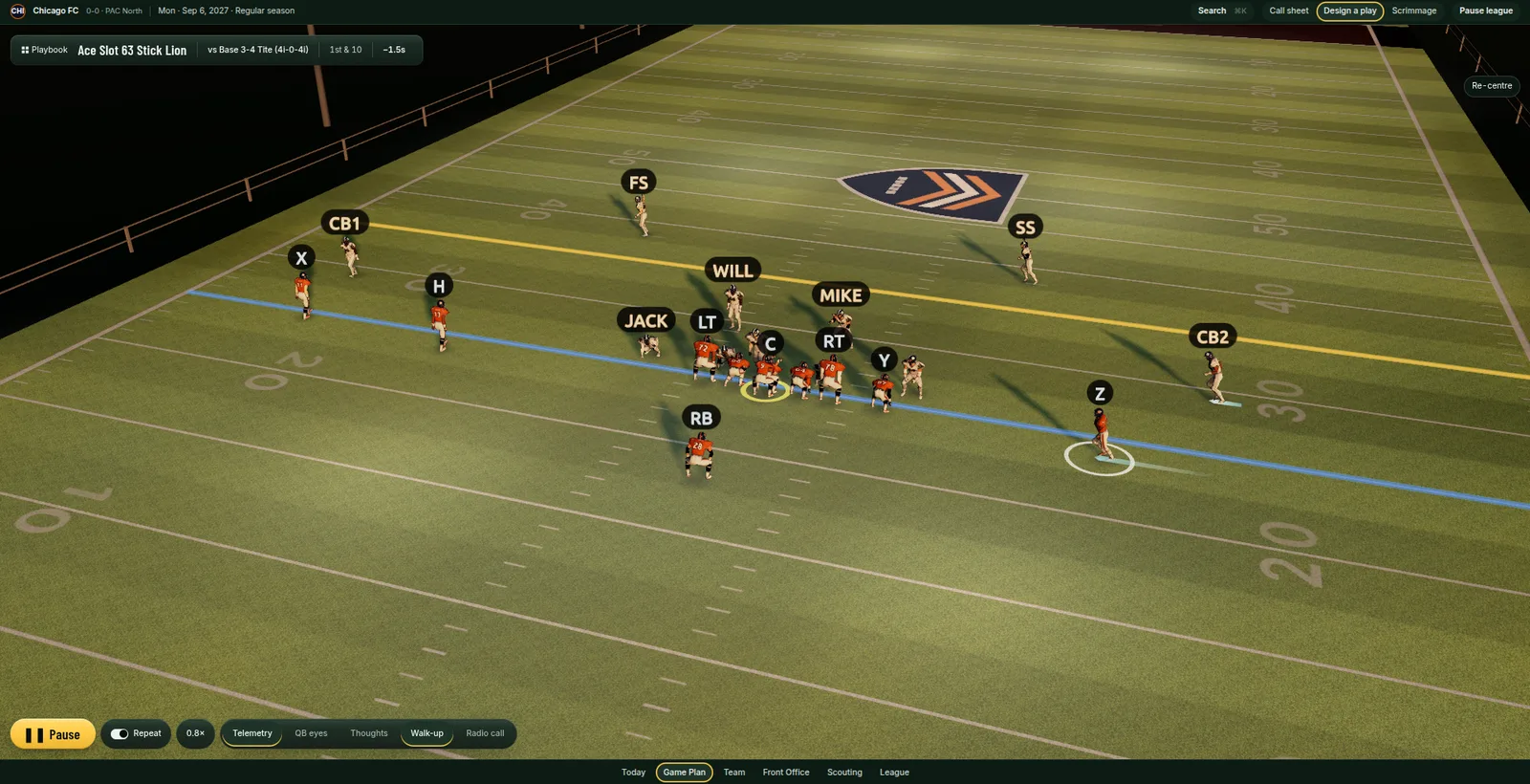
The same play on the field at 1.5 seconds before the snap: Z in motion, ringed, the defense lined up against him.
On the field: Z in motion with 1.5 seconds to the snap, and the defense has to answer.

Blocking schemes

Win up front.

Zone, gap, perimeter and protection, man by man.

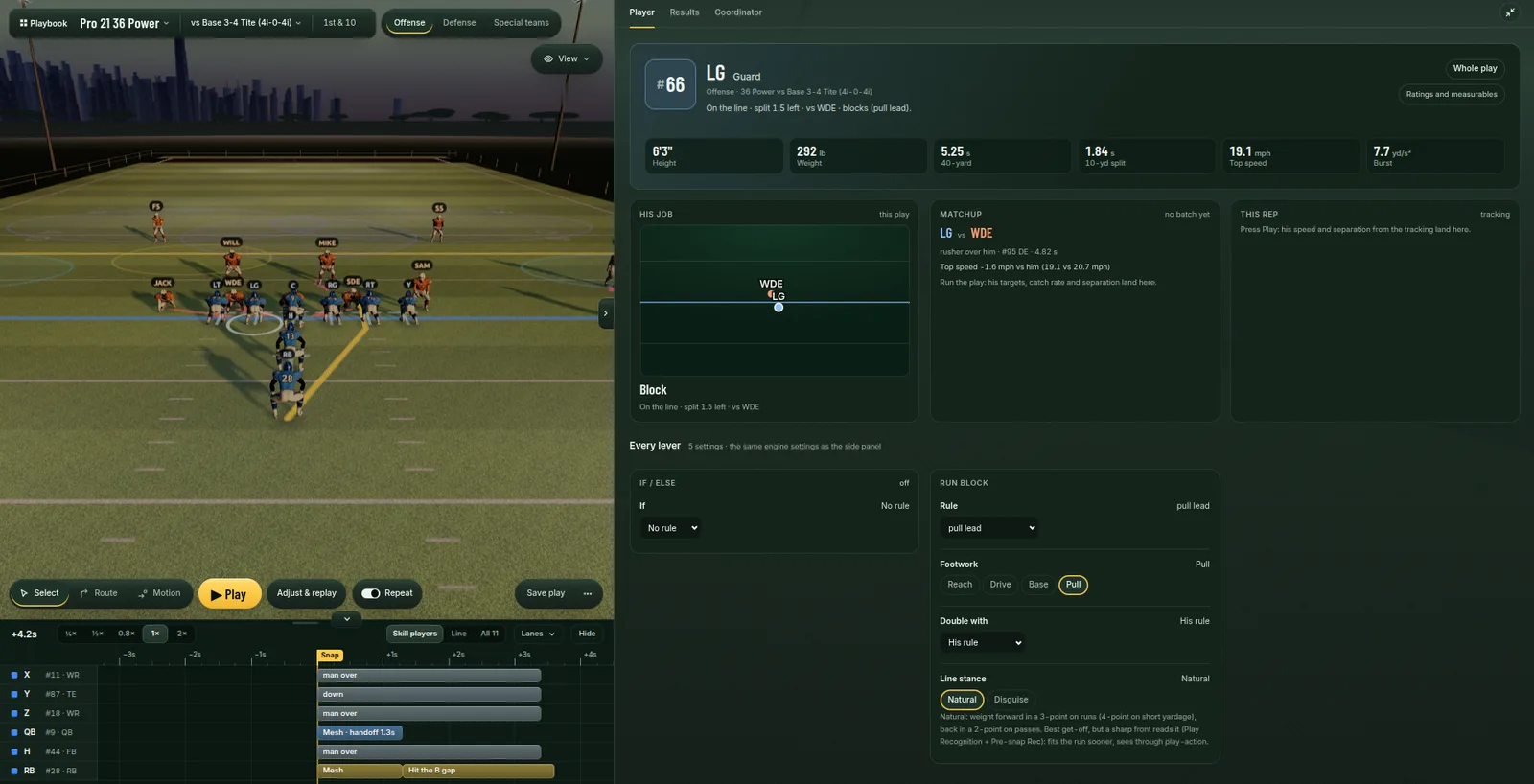
The Play Lab on Pro 21 36 Power against a Base 3-4: the left guard selected, his card open with his measurables, his job and his Run block levers set to Rule pull lead and Footwork Pull.
In the Play Lab: the left guard on Pro 21 36 Power. His Run block card reads Rule: pull lead. Footwork: Pull.
The football
Two families run the ball. Zone: the line steps together, covered and uncovered men combine, and the double team climbs to the backer. Gap: pullers, kick-outs and lead blocks build a door at one spot, as in power, counter and trap. Outside, receivers stalk and crack. Throwing it, the line slides, mans up, or moves the pocket off a boot.
In All-22
Give each lineman his block rule in the Inspector. Set the protection: slide, man, boot or a moving pocket. Let a back check-release. Give a receiver a stalk or a crack. Add a box-count kill at the line.
  • Block rule
  • Zone
  • Power
  • Counter
  • Trap
  • Slide
  • Man
  • Boot
  • Check-release
  • Stalk
  • Crack
  • Box count
The engine
Zone blocks aim at the near knee, with covered and uncovered combos and a double team that climbs to the second level. Gap schemes pull, kick out and lead, often aimed at the 3-technique. On a boot the line zones toward the fake, the back carries it out and the quarterback rolls away. On defense, unblocked backers and safeties fit their gap with leverage. Stalk blocks close the cushion, break down and mirror. At the point of attack it comes down to hand fighting, and blockers win on power, footwork, anchor and hand technique.
Try it in the Play Lab →
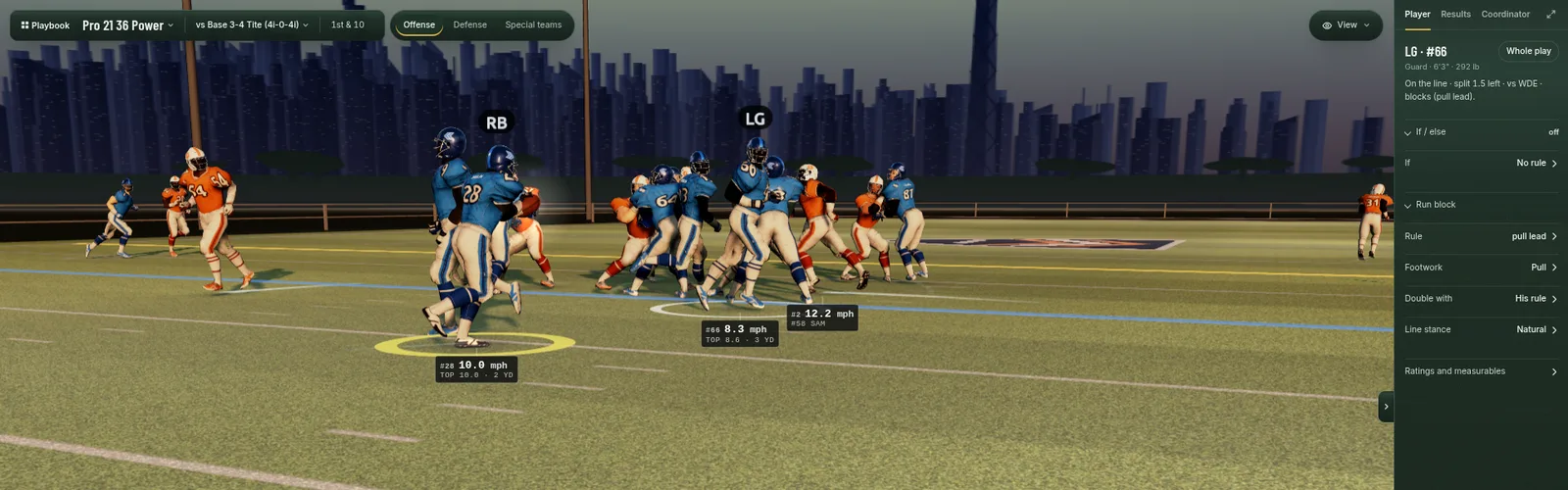
The same play on the field: the left guard pulling across the formation at 8.3 mph, the back on his hip at 10 mph, the Sam linebacker coming downhill.
On the field: the guard pulls across at 8.3 mph and leads the back into the hole.

Draw it Tuesday. Call it on game day.

Sign in

ALL-22

Tactical Football Simulator

The chalkboard.

Seven ideas a staff wins with before the ball moves. Each one three ways: the football, the control that runs it in the Play Lab, and what the engine does about it.

The timeline

Run the clock you drew.

Pre-snap and post-snap on one track per man.

The football
A play is a schedule. The motion man hits his landmark as the ball is snapped. The receiver breaks as the quarterback hits the top of his drop. Coaches teach it in steps and counts, and the play lives or dies on the timing.
In All-22
The timeline opens at the set, with a Cadence lane on top. The + button adds a motion. Each man's track shows his phases: stem, break and settle for a receiver; the drop and the reads for the quarterback. Drag a clip or a break point and the route is retimed.
  • Cadence lane
  • + Motion
  • Stem
  • Break
  • Settle
  • Drop
  • Reads
The engine
The players run the timing you set, from the set to the whistle. Move a break and the route runs on the new count.
Try it in the Play Lab →

Snap count

Make them guess.

Quick, on 1, on 2, on 3, hard count, freeze.

The football
The count is a weapon. Snap it on the first sound and the rush is a step late. Hold it to two and a jumpy end has to sit on his hands. A hard count dares the defense to blink first.
In All-22
Pick the count in the Cadence lane, play by play.
  • Quick
  • On 1
  • On 2
  • On 3
  • Hard count
  • Freeze
The engine
Whether a defender jumps comes from the count, how much you vary it, and his discipline, awareness and play recognition. Your own false starts come from the count, the tempo and your linemen's discipline. A hard count can freeze them; then you snap it, take a timeout or take the delay.
Try it in the Play Lab →

Tempo

Speed is a call.

Huddle, no-huddle, hurry, check-at-line.

The football
Go fast and the defense lines up in what it has: less time to disguise, less time to get the call in. The bill comes due at the line, where the offense loses time too.
In All-22
Set the tempo. Check-at-line gives the quarterback the call: he picks the play at the line from his read.
  • Huddle
  • No-huddle
  • Hurry
  • Check-at-line
The engine
In fast tempo the defense has a harder time disguising and getting set the way it would after a huddle. The offense pays its share: it gives up its own kills and checks.
Try it in the Play Lab →

At the line

Name the front.

Over, Under, Bear, 5-2, nickel. Then the rules fire.

The football
Before the snap the quarterback names the front. The front tells him where the 3-technique sits, where the bubble is, and where the run belongs.
In All-22
Write the play's rules: kill or flip the run away from the 3-technique, toward the bubble, or to the numbers. Add a Now or Bubble screen off the corner's cushion or the slot's space. He gives the check with a hand signal.
  • 4-3 Over
  • 4-3 Under
  • Bear
  • 5-2
  • Nickel
  • Kill
  • Flip
  • Now screen
  • Bubble screen
The engine
How fast he names the front, and how often he names it right, comes from his recognition ratings. The defense can bait a front and slide back late.
Try it in the Play Lab →

Gap inserts

A, B, C.

Inserts, gap releases and cracks by letter.

The Play Lab, one second before the snap on Doubles Right Slant-Flat: Z selected, his quick menu open on the field with Release set to B gap right, his slant drawn through it.
In the Play Lab: tap Z, open Release, pick B gap right. His slant now runs through the gap the line leaves him.
The football
Gaps count out from the center. A sits between center and guard, B between guard and tackle, C outside the tackle or between the tackle and a tight end. An insert sends a back into one of them. A crack sends an inside receiver down on the box.
In All-22
Give a back or fullback an insert, an inside receiver a crack, and any man a gap release, by letter: in the Inspector, or from his quick menu on the field.
  • Insert
  • Gap release
  • Crack
  • A
  • B
  • C
The engine
The gap is found from where the line stands on that snap: its splits, with or without an attached tight end. Widen the splits and the gaps move with them.
The same play on the field 1.9 seconds after the snap: Z through the B gap at 15.1 mph, the tag reads QB stared down Z, Mike jumped it.
On the field at +1.9 s: Z comes through the B gap at 15.1 mph. The quarterback stared him down, and the Mike jumped it.
Try it in the Play Lab →

WR motion

Make them show it.

Jet, orbit, across, zoom, return, short, insert.

The Play Lab at 2.8 seconds before the snap: Ace Slot 63 Stick. Z's drawn jog motion sits on his timeline track, his path dashed on the field, his job open in the Inspector.
In the Play Lab: Z's motion is a clip on his timeline track, 2.8 seconds before the snap.
The football
Motion is a question the defense has to answer. Send a receiver across and watch who goes with him. A man defender travels; a zone shifts. The answer tells the quarterback man or zone before the snap, and the new spacing can buy leverage or set a rub.
In All-22
From the timeline +, add a preset motion or draw the path by hand. Any of them can stop short.
  • Jet
  • Orbit
  • Across
  • Zoom
  • Return
  • Short
  • Insert
  • Drawn path
  • Stop short
The engine
The defense answers by its call. Lock: his man defender travels with him, the default against Cover 0, 1 and 2-Man. Bump: on motion across the formation, the defender on the far side takes him and the old one takes his man. Slide: in zone, the safeties cheat toward the motion and the apex defender shadows him.
The same play on the field at 1.5 seconds before the snap: Z in motion, ringed, the defense lined up against him.
On the field: Z in motion with 1.5 seconds to the snap, and the defense has to answer.
Try it in the Play Lab →

Blocking schemes

Win up front.

Zone, gap, perimeter and protection, man by man.

The Play Lab on Pro 21 36 Power against a Base 3-4: the left guard selected, his card open with his measurables, his job and his Run block levers set to Rule pull lead and Footwork Pull.
In the Play Lab: the left guard on Pro 21 36 Power. His Run block card reads Rule: pull lead. Footwork: Pull.
The football
Two families run the ball. Zone: the line steps together, covered and uncovered men combine, and the double team climbs to the backer. Gap: pullers, kick-outs and lead blocks build a door at one spot, as in power, counter and trap. Outside, receivers stalk and crack. Throwing it, the line slides, mans up, or moves the pocket off a boot.
In All-22
Give each lineman his block rule in the Inspector. Set the protection: slide, man, boot or a moving pocket. Let a back check-release. Give a receiver a stalk or a crack. Add a box-count kill at the line.
  • Block rule
  • Zone
  • Power
  • Counter
  • Trap
  • Slide
  • Man
  • Boot
  • Check-release
  • Stalk
  • Crack
  • Box count
The engine
Zone blocks aim at the near knee, with covered and uncovered combos and a double team that climbs to the second level. Gap schemes pull, kick out and lead, often aimed at the 3-technique. On a boot the line zones toward the fake, the back carries it out and the quarterback rolls away. On defense, unblocked backers and safeties fit their gap with leverage. Stalk blocks close the cushion, break down and mirror. At the point of attack it comes down to hand fighting, and blockers win on power, footwork, anchor and hand technique.
The same play on the field: the left guard pulling across the formation at 8.3 mph, the back on his hip at 10 mph, the Sam linebacker coming downhill.
On the field: the guard pulls across at 8.3 mph and leads the back into the hole.
Try it in the Play Lab →

Draw it Tuesday. Call it on game day.

Play nowOpen the Play Lab